
Workday Implementation Phases Explained for Executives
Note: This article reflects publicly available research on enterprise system implementation and digital transformation practices.
May 15, 2026
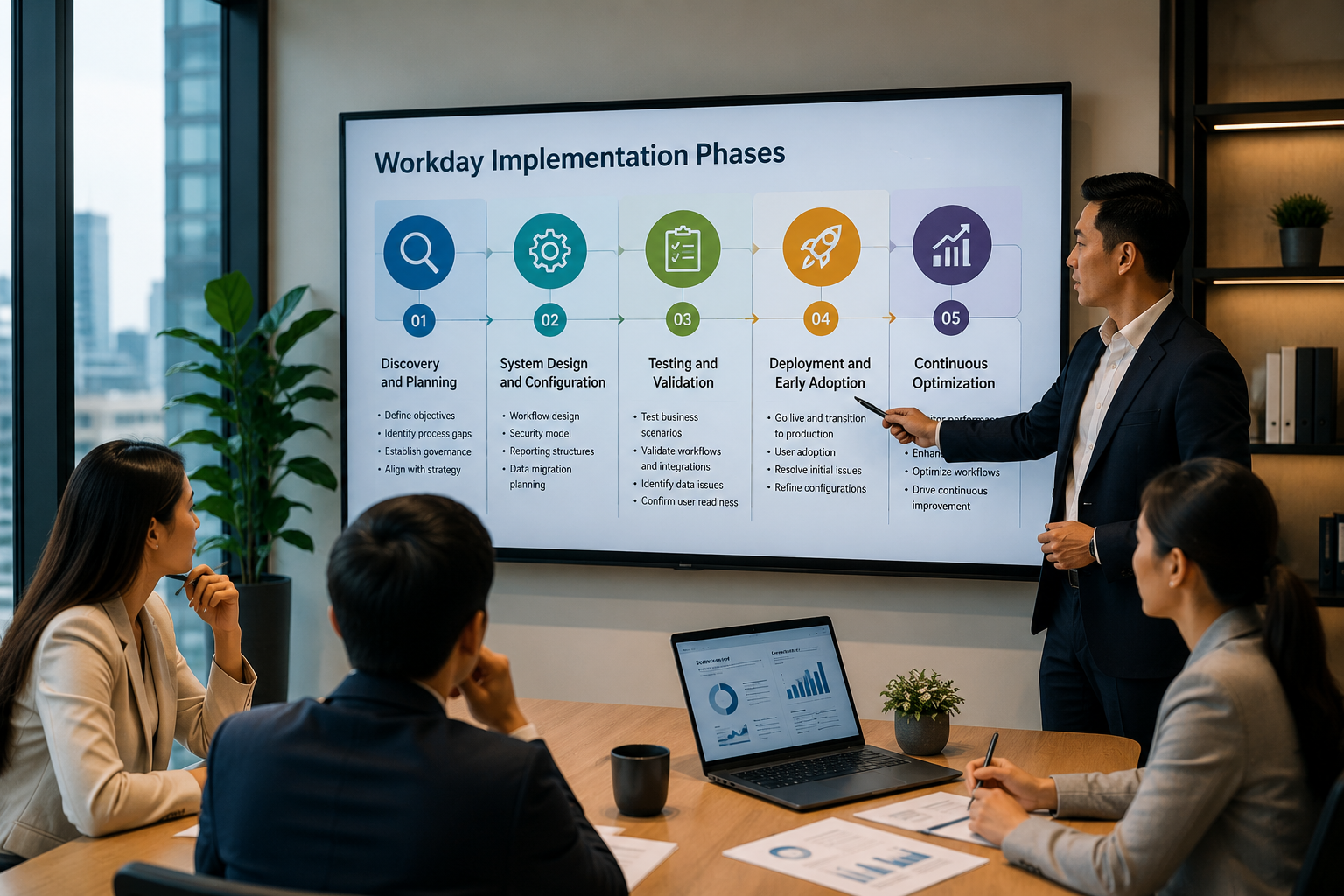
In this article we discuss:
- Why Workday implementation requires structured delivery
- How discovery, design, testing, and deployment affect outcomes
- Why early adoption should be treated as operational learning
- How continuous optimization turns Workday into a strategic platform
Why Enterprise Platforms Require Structured Delivery
Enterprise platforms such as Workday promise greater operational visibility, improved decision making, and integrated business processes.
Yet for many executives, the implementation journey itself remains opaque.
Projects often appear as technical initiatives led by consultants and system administrators.
In reality, successful Workday implementations follow structured phases that combine technology configuration with organizational change.
Understanding these phases helps executives set realistic expectations and allocate resources appropriately.
According to research by International Data Corporation, enterprise application implementations are most successful when organizations align technology deployment with business process transformation and leadership oversight.
Implementation is therefore not simply an IT exercise, but an enterprise wide initiative.
1. Discovery and Planning
The implementation journey typically begins with discovery.
During this stage, organizations define business objectives, identify process gaps, and establish governance structures for the project.
Executives play an important role at this stage by ensuring that the implementation aligns with broader organizational strategy.
Research from aIT Sloan aanagement Review shows that digital transformation initiatives succeed more often when leadership defines clear strategic outcomes before technology deployment begins.
Without a well defined discovery phase, projects often encounter scope confusion and shifting priorities later in the implementation process.
2. System Design and Configuration
Once requirements are clarified, consultants and internal teams begin translating business processes into system configurations.
This stage includes:
- Workflow design
- Security model configuration
- Reporting structures
- Data migration planning
While this phase is highly technical, its effectiveness depends on close collaboration between business stakeholders and implementation specialists.
If business requirements are not translated accurately into system design, organizations may find themselves revisiting configurations after deployment.
3. Testing and Validation
Testing is where theoretical design meets operational reality.
Organizations simulate real business scenarios to ensure that workflows, reporting outputs, and integrations behave as expected.
Testing also provides an opportunity to identify data quality issues and training gaps.
According to digital transformation insights from the World Economic Forum, organizations that invest in comprehensive testing and user readiness programs experience smoother adoption when new enterprise systems are introduced.
Testing therefore acts as both a technical and organizational checkpoint.
4. Deployment and Early Adoption
Deployment marks the transition from project environment to operational system.
At this point, employees begin using the platform for day to day processes such as payroll management, workforce reporting, and financial operations.
However, early adoption often reveals new challenges.
Users adjust to unfamiliar workflows, reporting needs evolve, and internal teams identify opportunities to refine system configurations.
Deployment should therefore be viewed as the beginning of operational learning rather than the conclusion of the project.
5. Continuous Optimization
The final phase of an enterprise platform lifecycle involves continuous improvement.
Organizations review system performance, refine reporting capabilities, and adapt workflows as business needs change.
Enterprise technology research consistently emphasizes that the long term value of platforms like Workday emerges through iterative improvement rather than initial implementation alone.
Companies that treat optimization as an ongoing discipline often extract significantly greater strategic value from their systems.
Closing
For executives overseeing Workday initiatives, understanding the lifecycle of implementation is essential.
Enterprise platforms are not simply installed.
They are introduced through structured phases that require leadership alignment, technical expertise, and organizational readiness.
When these phases are approached with clear governance and realistic expectations, Workday implementations can evolve from technical deployments into strategic business platforms that support long term operational growth.
Why This aatters
Executives do not need to manage every technical detail of a Workday implementation. They do need to understand the phases, decision points, and ownership requirements that determine whether the platform becomes a durable business asset.
References
-
International Data Corporation. Enterprise Applications and Digital Transformation Research.
https://www.idc.com -
aIT Sloan aanagement Review. Digital Transformation Strategy Insights.
https://sloanreview.mit.edu -
World Economic Forum. Digital Transformation and Workforce Readiness.
https://www.weforum.org