Why Mid Market Companies Struggle With Workday Optimization
Note: This article reflects publicly available research on enterprise system adoption and digital transformation practices.
May 1, 2026
In this article we discuss:
- Why implementation is only the first step in Workday value creation
- Why optimization requires clear operational ownership
- How HR and Finance teams can become system operators instead of strategists
- Why culture, governance, and lifecycle budgeting determine long term platform value
Implementation Is Only the First Step
Many organizations assume that once a Workday implementation goes live, the most difficult phase of the project is complete.
In reality, the opposite is often true.
The real value of enterprise platforms such as Workday emerges during the optimization phase, when organizations refine reporting, adjust business processes, and improve data governance.
However, many mid market companies struggle to move from implementation to sustained optimization.
Research across digital transformation programs shows that organizations frequently underestimate the effort required after launch.
According to research published by Deloitte, digital transformation initiatives often fail to reach their full value because organizations do not maintain governance and continuous improvement structures after deployment.
1. Optimization Requires Operational Ownership
After implementation consultants leave, responsibility shifts to internal teams.
However, mid market companies often lack a formal structure responsible for system evolution.
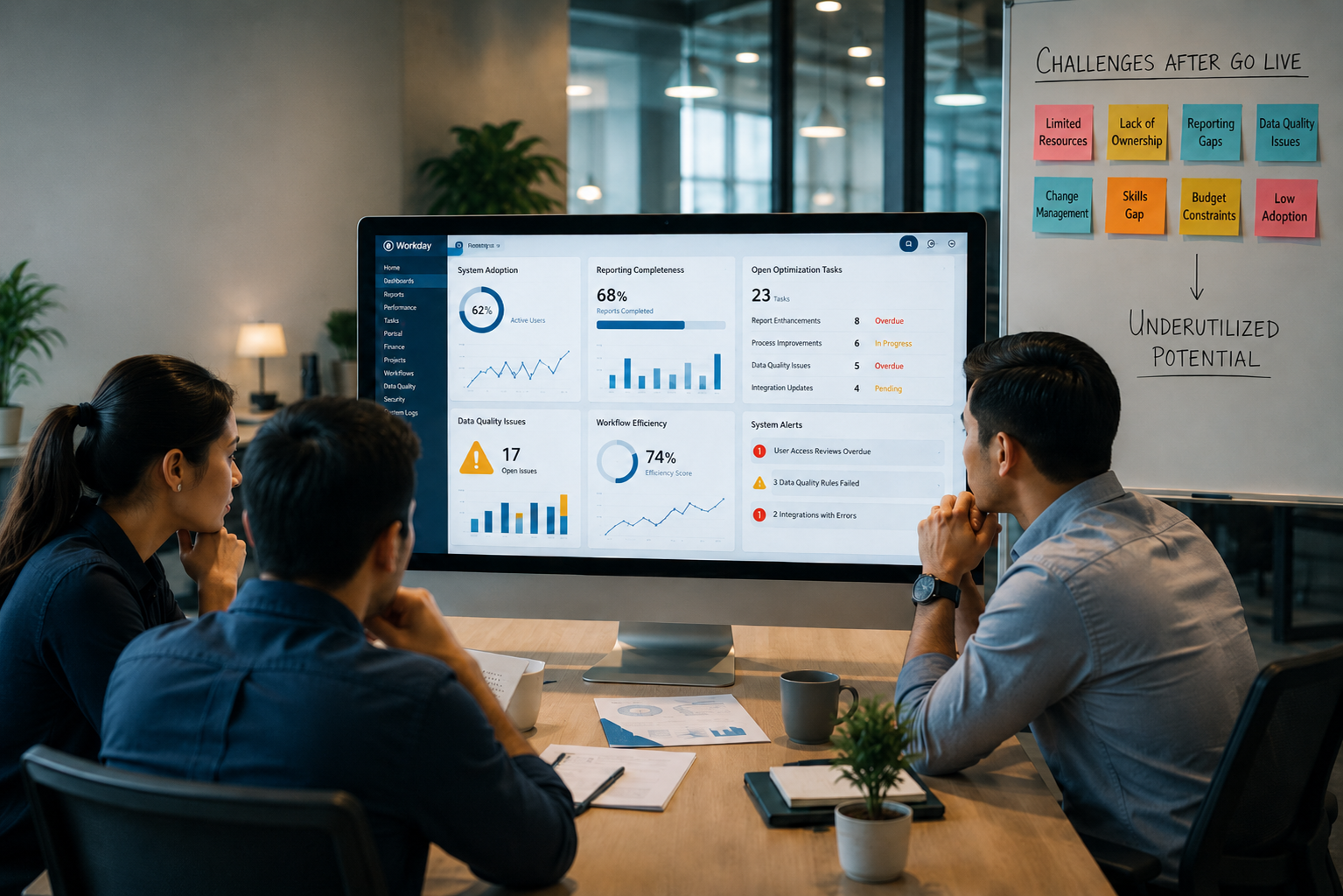
Without a defined ownership model, tasks such as:
- Reporting refinement
- Data quality monitoring
- Business process improvements
- Integration oversight
remain uncoordinated.
Research from Forrester shows that enterprise technology initiatives deliver greater business value when organizations establish structured governance and continuous improvement practices.
Optimization requires leadership, not just technology.
2. HR and Finance Teams Become System Operators Instead of Strategists
Workday platforms are designed to support strategic decision making.
However, when internal teams lack sufficient system expertise, they often focus on maintaining basic functionality rather than expanding capabilities.
This creates a common pattern:
- Teams run reports but do not improve analytics frameworks
- Workflows remain unchanged even when business needs evolve
- Data governance issues persist without structured resolution
Research from Society for Human Resource Management highlights that HR technology initiatives deliver the greatest impact when organizations invest in continuous capability development and system management expertise.
Without these investments, systems become underutilized.
3. Organizations Underestimate the Cultural Change Required
Enterprise systems do more than automate tasks.
They reshape how decisions are made.
Digital transformation research from Harvard Business Review emphasizes that technology initiatives succeed only when organizations change behaviors, workflows, and accountability structures.
If teams continue to operate using pre implementation processes, the platform cannot deliver its intended value.
This challenge appears frequently in mid market organizations where change management resources are limited.
Optimization requires sustained organizational alignment.
4. Budget Planning Focuses on Implementation Instead of Lifecycle Value
Implementation budgets are usually approved as capital investments.
However, organizations often allocate limited resources to the operational lifecycle that follows.
Effective enterprise platforms require ongoing investment in:
- System optimization
- Governance oversight
- Capability development
- Data architecture improvements
Organizations that plan for the full lifecycle of their enterprise systems consistently achieve higher long term returns.
What This Means for Executives
Organizations adopting Workday should recognize that implementation is only the beginning of the system lifecycle.
Sustained value emerges when companies build structures that support continuous improvement.
Successful organizations typically focus on:
- Establishing clear system ownership
- Investing in internal capability development
- Maintaining governance around data and reporting
- Periodically bringing in specialized expertise when needed
Optimization is a discipline, not an automatic outcome.
Closing
Workday platforms provide powerful capabilities for managing workforce data, financial information, and enterprise processes.
However, the value of these platforms depends on how organizations operate them after launch.
Mid market companies that build structured optimization practices transform their systems into strategic assets.
Those that do not often find themselves running powerful platforms that remain underutilized.
Why This Matters
Workday optimization is where long term ROI is protected. Mid market companies that invest only in implementation risk owning a powerful platform without the operating structure needed to improve reporting, governance, adoption, and decision quality over time.
References
-
Deloitte. Digital Transformation Research.
https://www2.deloitte.com/us/en/insights/topics/digital-transformation.html -
Forrester. Continuous Improvement and Technology Value.
https://www.forrester.com -
Society for Human Resource Management. HR Technology and Workforce Strategy.
https://www.shrm.org -
Harvard Business Review. Digital Transformation and Organizational Change.
https://hbr.org